
Cost-Effective Industrial Automation Solutions: Your Complete Guide to Sourcing Directly from China in 2026

Introduction
In today's competitive manufacturing landscape, companies worldwide are seeking innovative ways to reduce operational costs while maintaining high-quality standards. Industrial automation has become essential for improving productivity, but the costs associated with automation equipment can be prohibitive when sourced through traditional channels. This is where direct sourcing from China presents a game-changing opportunity.

Global companies are discovering that by partnering with the right sourcing experts and connecting directly with Chinese manufacturers, they can achieve cost savings of 40-60% without compromising on quality. At Confia International Trade Co. Ltd, we've helped hundreds of businesses navigate the complexities of China sourcing, and we're here to share our expertise with you.
Why Source Industrial Automation from China?
China's Manufacturing Dominance
China has established itself as the world's manufacturing powerhouse, producing over 28% of global manufacturing output. The country's industrial automation sector has experienced exponential growth, with Chinese manufacturers investing billions in advanced technology, robotics, and precision engineering.
Key advantages include:
Advanced Manufacturing Capabilities: Chinese factories have modernized significantly over the past decade. Many facilities now feature state-of-the-art production lines that rival or exceed Western standards. From programmable logic controllers (PLCs) to sophisticated robotic systems, Chinese manufacturers produce virtually every type of industrial automation equipment.
Economies of Scale: The sheer volume of production in China creates cost advantages that are difficult to match elsewhere. Manufacturers benefit from bulk purchasing of raw materials, streamlined production processes, and a highly developed supply chain ecosystem. These savings are passed directly to buyers who source directly from factories.
Competitive Pricing Structure: When you eliminate intermediaries and work directly with manufacturers, the cost structure changes dramatically. Distributors, agents, and middlemen typically add 100-300% markup to factory prices. Direct sourcing allows you to access factory-direct pricing while maintaining quality standards.
Rapid Innovation: Chinese manufacturers are increasingly focused on innovation and R&D. Many companies invest 10-15% of revenue into developing new automation technologies, ensuring they remain competitive in the global market.
The True Cost Savings
Let's examine real-world cost comparisons based on our experience at Confia International Trade:

Example 1 - Robotic Arm Assembly Line:
Domestic supplier cost: $85,000
Western distributor importing from China: $52,000
Direct China sourcing with Confia: $32,000
Your savings: $53,000 (62% reduction)
Example 2 - PLC Control Systems:
Domestic supplier cost: $12,500
Western distributor: $8,500
Direct China sourcing: $4,800
Your savings: $7,700 (62% reduction)
Example 3 - Automated Conveyor System:
Domestic supplier cost: $45,000
Western distributor: $31,000
Direct China sourcing: $18,500
Your savings: $26,500 (59% reduction)
These aren't hypothetical numbers—these are actual cost comparisons from projects we've managed for our clients. The savings become even more significant when you're ordering multiple units or complete automation systems.
Ensuring Quality: Your Top Priority
One of the most common concerns we hear is: "How can I be sure the quality matches my standards?" This is absolutely the right question to ask, and it's where having an experienced sourcing partner becomes invaluable.
The Quality Assurance Framework
Pre-Production Quality Control: Quality begins before manufacturing starts. At Confia International Trade, we implement a comprehensive pre-production inspection that includes verifying raw materials, reviewing technical specifications, checking production equipment calibration, and confirming that workers are properly trained on your specific requirements.
During Production Monitoring: Regular inspections during the manufacturing process catch issues before they become costly problems. Our quality control team conducts in-process inspections at critical production stages, monitoring adherence to technical drawings and specifications, checking dimensional accuracy and tolerances, and verifying proper assembly procedures and testing protocols.
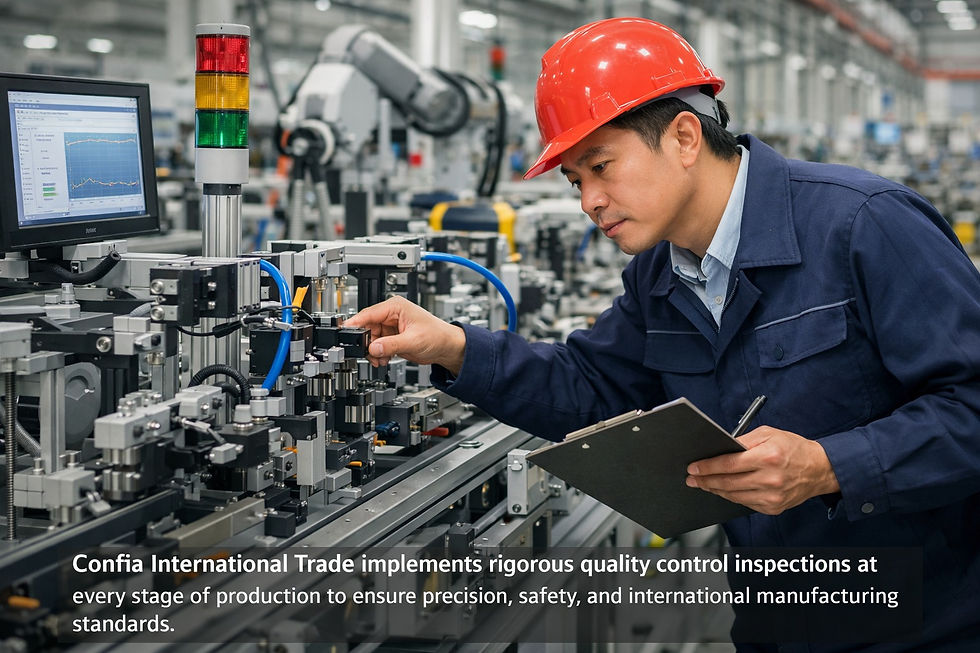
Final Product Inspection: Before shipment, every unit undergoes a thorough final inspection covering functionality testing, safety compliance verification, packaging quality assessment, and documentation review, including certificates, manuals, and warranty information.
Third-Party Testing and Certification: For critical applications, we arrange independent third-party testing through internationally recognized agencies. This provides additional assurance that products meet international standards, including ISO certifications, CE marking for European markets, UL listing for North American markets, and industry-specific certifications as needed.
Understanding Chinese Quality Tiers
Not all Chinese manufacturers operate at the same quality level. Understanding the different tiers helps you make informed decisions:
Tier 1 - Premium Manufacturers: These are factories that supply major international brands and have achieved international quality certifications. They often have in-house R&D departments, advanced testing facilities, and strict quality management systems. Pricing is higher but still 40-50% below Western equivalents.
Tier 2 - Mid-Range Manufacturers: These factories produce good-quality products with reasonable pricing. They may serve both domestic and international markets and typically have ISO certification. With proper quality control oversight, these manufacturers can deliver excellent value at 50-60% cost savings.
Tier 3 - Budget Manufacturers: While these factories offer the lowest prices, quality can be inconsistent. We generally recommend avoiding this tier for industrial automation unless you have very basic requirements and robust quality control in place.
At Confia International Trade, we maintain relationships with verified Tier 1 and Tier 2 manufacturers across all automation categories. Our supplier vetting process ensures you work with factories capable of meeting your specific quality requirements.
Finding and Vetting Reliable Suppliers
The success of your China sourcing initiative depends heavily on selecting the right manufacturing partners. Here's our proven approach to supplier identification and verification.
Initial Supplier Research
Industry-Specific Supplier Databases: We maintain an extensive database of verified automation manufacturers organized by specialization, including robotics and robotic systems, PLCs and control systems, sensors and actuators, conveyor systems and material handling, vision systems and inspection equipment, and servo motors and drives.
Trade Shows and Industry Events: China hosts numerous specialized trade shows where you can meet manufacturers face-to-face. Key events include the China International Industry Fair (CIIF) in Shanghai, the Industrial Automation Show in Shenzhen, and the Canton Fair's machinery section. Our team attends these events regularly to identify emerging manufacturers and maintain relationships with existing partners.
Supplier Verification Checklist
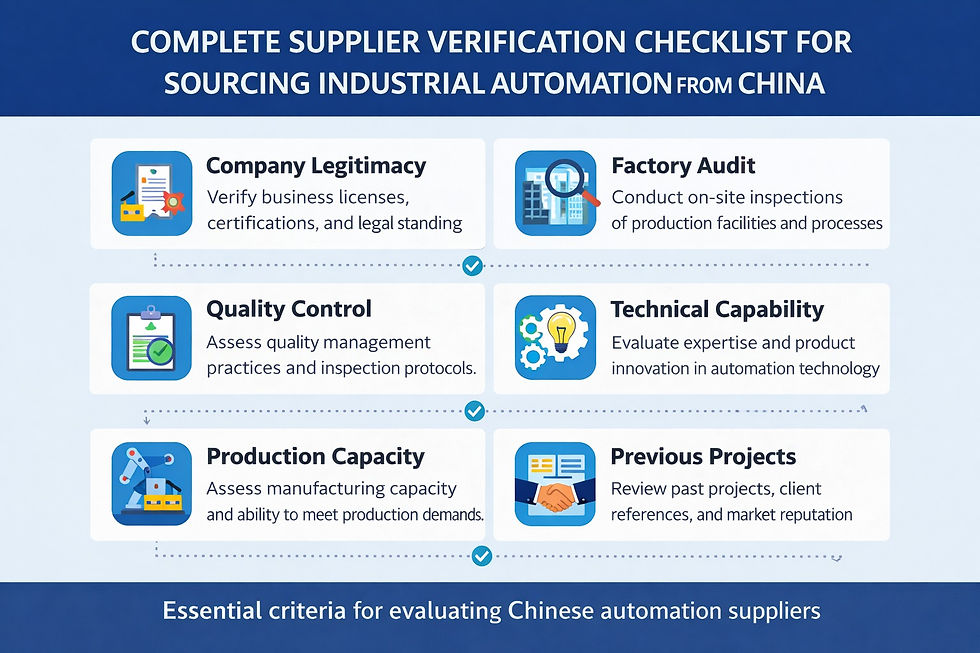
Before recommending any supplier to our clients, we conduct thorough due diligence:
Business Credentials Verification: We verify business licenses and registration documents, confirm company ownership and financial stability, check credit history and payment track records, and review any litigation or legal issues.
Manufacturing Capabilities Assessment: During factory audits, we evaluate production capacity and current utilization rates, assess equipment age and maintenance standards, review quality control systems and procedures, and examine R&D capabilities and engineering support.
Quality Systems Review: We verify ISO 9001 and industry-specific certifications, review quality control documentation and procedures, assess testing equipment and calibration records, and evaluate corrective action processes for defects.
Previous Customer References: Speaking with existing customers provides invaluable insights. We contact international clients who've worked with the supplier, review order history and consistency of quality, check complaint resolution and after-sales support, and assess communication responsiveness and English proficiency.
Production Sample Evaluation: Before committing to large orders, always request production samples. We arrange for sample production to your exact specifications, conduct independent testing and quality verification, compare samples against your requirements and standards, and identify any necessary modifications before mass production.
Red Flags to Watch For
Through years of experience, we've learned to identify warning signs that indicate potential problems:
Unwillingness to provide factory tours or video calls - Legitimate manufacturers are proud of their facilities and happy to show them.
Prices significantly below market rates - If pricing seems too good to be true, it usually is. Extremely low prices often indicate substandard materials or cutting corners on quality.
Lack of relevant certifications - Reputable automation manufacturers will have appropriate industry certifications and be willing to share documentation.
Poor communication or vague responses - If a supplier can't clearly answer technical questions or is evasive about their processes, consider it a red flag.
Pressure for immediate decisions - Professional manufacturers understand that sourcing decisions take time and won't pressure you into rushed commitments.
Inconsistent information - Pay attention if different company representatives provide conflicting information about capabilities, pricing, or terms.
Navigating MOQ and Payment Terms
Understanding minimum order quantities and payment structures is crucial for successful sourcing from China.
Minimum Order Quantities (MOQ)
Chinese manufacturers typically have MOQ requirements, but these are often more flexible than you might expect:
Standard MOQ Ranges by Product Type: For robotic systems and complete automation lines, MOQs are typically 1-5 units since these are high-value items. Control systems and PLCs usually require 10-50 units, depending on customization. Sensors and standard components might have MOQs of 100-500 units. Conveyor systems and material handling equipment typically require 1-10 systems.
Negotiating Lower MOQs: At Confia International Trade, we often successfully negotiate reduced MOQs for our clients by consolidating orders from multiple buyers to meet factory minimums, agreeing to accept longer lead times when factories can slot production into existing runs, paying slightly higher per-unit costs for smaller initial orders, and committing to larger volumes in future orders once quality is proven.
The First Order Strategy: We recommend a graduated approach for new supplier relationships. Start with a smaller initial order to verify quality and compatibility, even if per-unit costs are slightly higher. Once you're satisfied with the product and the relationship, subsequent orders at full MOQ will capture maximum cost savings.
Payment Terms and Risk Mitigation
Payment terms require careful negotiation to protect both parties' interests:
Standard Payment Structures: The most common payment arrangement is a 30% deposit upon order confirmation, with 70% balance before shipment. Some established suppliers may offer 30/70 with the balance paid against a copy of shipping documents. For large orders, some flexibility exists in structuring payments around production milestones.
Payment Methods: We recommend using secure payment methods that offer buyer protection. Bank wire transfers through letters of credit (L/C) provide maximum security for large transactions. For smaller orders, platforms like Alibaba's Trade Assurance offer built-in payment protection. We advise against Western Union or personal account transfers, which offer no recourse if issues arise.
Escrow Services: For first-time orders or when working with new suppliers, consider using escrow services. Payment is held by a trusted third party and released to the supplier only after you confirm receipt and acceptance of goods meeting specifications.
Quality Holdbacks: For large projects, we sometimes negotiate payment structures that include holdbacks—a portion of payment retained until final installation and acceptance testing confirm everything meets specifications.
At Confia International Trade, we manage all payment coordination on behalf of our clients, ensuring proper documentation, secure transactions, and compliance with international trade regulations. Our escrow services provide additional peace of mind for first-time buyers.
Logistics and Shipping: Getting Your Equipment Home
Efficient logistics management is critical to realizing the full cost benefits of China sourcing. Poor logistics planning can erode your cost savings through delays, damage, or unexpected fees.

Shipping Methods and Cost Considerations
Sea Freight (Ocean Shipping): This is the most economical option for industrial automation equipment. Full Container Load (FCL) is most cost-effective when you have enough cargo to fill a 20-foot or 40-foot container. For smaller shipments, Less than Container Load (LCL) allows you to share container space with other shippers. Transit times typically range from 20-45 days, depending on destination port, but cost savings of 70-80% compared to air freight make this the preferred choice for most automation equipment.
Air Freight: For urgent shipments or high-value, lightweight equipment, air freight offers speed at a premium cost. Transit times of 5-10 days make this suitable for time-sensitive projects, replacement parts needed urgently, or prototype equipment for testing. While costs are significantly higher, the ability to start production sooner sometimes justifies the expense.
Rail Freight: The China-Europe rail route has become increasingly popular, offering a middle ground between sea and air freight. Transit times of 15-20 days are faster than sea freight, and costs are 30-50% less than air freight. This option works well for European customers seeking faster delivery without air freight premiums.
Incoterms: Understanding Your Responsibilities
Incoterms define who handles what in international shipping. Understanding these terms is essential:
FOB (Free on Board): The supplier delivers goods to the shipping port and loads them onto the vessel. You're responsible for ocean freight, insurance, and all costs from that point forward. This is the most common term for China sourcing, as it gives you control over shipping arrangements and costs.
CIF (Cost, Insurance, and Freight): The supplier arranges and pays for ocean freight and insurance to your destination port. This simplifies logistics, but you have less control over carriers and routing. Ensure you understand exactly what insurance coverage is included.
DDP (Delivered Duty Paid): The supplier handles everything, including customs clearance and delivery to your facility. This is the most convenient but typically most expensive option. It's useful when you lack import experience or want turnkey delivery.
EXW (Ex Works): The supplier makes goods available at their factory, and you arrange everything from pickup onward. This gives maximum control but requires you or your logistics partner to handle all transportation, which can be complex in China.
At Confia International Trade, we recommend FOB terms for most clients, and we coordinate all shipping logistics on your behalf through our network of freight forwarders. We secure competitive shipping rates, manage documentation, track shipments in real-time, and coordinate customs clearance in your country.
Customs and Import Compliance
Navigating customs can be daunting, but proper preparation ensures smooth clearance:
Required Documentation: Essential documents include a commercial invoice detailing goods and their value, a packing list describing contents and dimensions, a bill of lading (for sea freight) or airway bill (for air freight), a certificate of origin, and product-specific certifications (safety certificates, quality certificates, test reports).
Duty and Tax Calculations: Import duties vary by country and product classification. We help you determine the Harmonized System (HS) code for your equipment, calculate applicable duty rates, estimate taxes (VAT, GST, etc.), and identify potential duty exemptions or reductions.
Compliance Requirements: Certain automation equipment may require special certifications or approvals. We ensure compliance with electrical safety standards for your market, electromagnetic compatibility (EMC) requirements, environmental regulations (RoHS, REACH), and industry-specific standards.
Customs Broker Services: We collaborate with experienced customs brokers in your country who specialize in the import and export ofindustrial equipment. They handle classification and valuation, prepare and submit customs declarations, coordinate inspections if required, and ensure rapid clearance to avoid storage fees.
Common Pitfalls and How to Avoid Them
Learning from others' mistakes can save you significant time, money, and frustration. Here are the most common pitfalls we see and how to avoid them.
Pitfall 1: Insufficient Technical Specifications
The Problem: Many buyers provide vague specifications or assume suppliers will understand their requirements. This leads to products that don't quite meet needs, requiring costly modifications or replacements.
The Solution: Create detailed technical specifications including dimensional drawings with tolerances, electrical specifications (voltage, current, power requirements), environmental conditions (temperature range, humidity, dust/water ingress protection), material requirements, performance parameters, interface and compatibility requirements, and safety and regulatory compliance needs. At Confia International Trade, we help you develop comprehensive specifications that leave no room for misinterpretation.
Pitfall 2: Ignoring Intellectual Property Protection
The Problem: Concerns about IP theft in China are often overstated but shouldn't be ignored entirely. Some buyers fail to take basic precautions, potentially exposing proprietary designs or processes.
The Solution: Register your trademarks and patents in China (IP rights are territorial), use non-disclosure agreements (NDAs) before sharing sensitive information, compartmentalize information by sharing only what each supplier needs to know, register designs with Chinese authorities when applicable, and work with reputable manufacturers who have established international reputations to protect. We guide clients through IP protection strategies appropriate to their situation and risk level.
Pitfall 3: Underestimating Lead Times
The Problem: Buyers often expect faster production than is realistic, leading to project delays and rushed production that compromises quality.
The Solution: Understand realistic timelines. Sample production typically takes 2-4 weeks, tooling and setup require 2-6 weeks depending on complexity, mass production ranges from 4-12 weeks based on order size and complexity, quality inspection needs 1-2 weeks, and shipping takes 1-6 weeks depending on method. Add buffer time for potential delays, including Chinese holidays (especially Chinese New Year), customs clearance variations, and potential quality issues requiring rework. We provide realistic timeline projections and project management to keep everything on track.
Pitfall 4: Poor Communication
The Problem: Language barriers and time zone differences can lead to misunderstandings, errors, and frustration.
The Solution: Establish clear communication protocols with designated points of contact on both sides, regular video calls to discuss progress and concerns, written confirmation of all important decisions, visual aids (photos, diagrams) to clarify requirements, and translation services for technical documents when needed. As your sourcing partner, Confia International Trade serves as your communication bridge, ensuring nothing gets lost in translation and all parties stay aligned.
Pitfall 5: Focusing Only on Price
The Problem: Choosing suppliers based solely on the lowest price often leads to quality issues, delivery delays, and hidden costs that negate any potentialsavings.
The Solution: Evaluate the total cost of ownership, including product quality and reliability, delivery reliability, after-sales support, communication effectiveness, and long-term partnership potential. Sometimes paying slightly more for a more reliable supplier saves money overall through fewer defects, faster delivery, and better support.
Pitfall 6: Skipping Quality Inspections
The Problem: To save money, some buyers skip professional inspections, only to discover problems after expensive shipments arrive.
The Solution: Never skip quality control. The cost of professional inspection (typically $300-800 per day) is minimal compared to the cost of receiving defective goods. Catching problems before shipment allows immediate correction without additional shipping costs or production delays. Our quality control services are built into our sourcing packages because we know they're essential for success.
Success Stories: Real Results from Direct China Sourcing
Nothing illustrates the potential of direct China sourcing better than real examples from companies we've helped.

Case Study 1: Automotive Parts Manufacturer
Challenge: A mid-sized automotive parts manufacturer in Germany needed to automate their assembly line but found quotes from European suppliers prohibitively expensive at €450,000.
Solution: Confia International Trade identified three qualified Chinese manufacturers specializing in automotive automation. After factory audits and sample testing, we sourced a complete automated assembly system including robotic arms, conveyor systems, vision inspection systems, and PLC control systems.
Results: Total cost of €175,000 (61% savings), system exceeded original specifications, installation completed 3 weeks ahead of schedule, ongoing support and spare parts access through Confia, and ROI achieved in 14 months vs. projected 36 months with European supplier.
Client Testimonial: "We were skeptical about China sourcing for such a critical system, but Confia's thorough vetting process and quality control gave us confidence. The equipment has performed flawlessly for 18 months, and the cost savings allowed us to automate two additional lines ahead of schedule."
Case Study 2: Electronics Contract Manufacturer
Challenge: A US-based electronics contract manufacturer needed to upgrade quality control with automated optical inspection (AOI) systems. Domestic quotes ranged from $125,000-$180,000 per unit, and they needed four units.
Solution: We sourced AOI systems from a Tier 1 Chinese manufacturer that supplies major international brands. The supplier provided customization for their specific board types and extensive training and technical support.
Results: Cost of $52,000 per unit (59-71% savings), total investment of $208,000 vs. $500,000+ domestically, inspection accuracy met or exceeded original specifications, systems integrated seamlessly with existing equipment, and comprehensive 2-year warranty with responsive technical support.
Case Study 3: Food Processing Company
Challenge: An Australian food processing company required automated packaging lines compliant with food safety regulations. They needed rapid deployment to meet increased demand but faced long lead times from Australian suppliers.
Solution: Confia International Trade sourced packaging automation from a Chinese manufacturer certified for food processing applications, coordinated expedited production and air freight for critical components, and arranged for Australian food safety certification and compliance verification.
Results: Total cost savings of 48% compared to domestic alternatives, delivery in 8 weeks vs. 26 weeks quoted domestically, full compliance with Australian food safety standards, successful health inspection on first attempt, and production capacity increased by 300%.
Client Feedback: "The speed and cost savings were remarkable, but what impressed us most was Confia's attention to our regulatory requirements. They understood that food safety compliance was non-negotiable and ensured every detail met Australian standards."
Common Themes from Success Stories
Reviewing dozens of successful projects reveals consistent factors:
Professional sourcing partner made the difference - Companies that worked with experienced partners like Confia International Trade had significantly higher success rates than those attempting direct sourcing independently.
Quality control was never compromised - Success stories prioritized quality assurance from day one, with professional inspections at every stage.
Clear communication protocols - Successful projects established strong communication frameworks with regular updates and documentation.
Realistic expectations - Companies that understood Chinese manufacturing capabilities and limitations, including appropriate lead times and MOQs, had smoother experiences.
Long-term perspective - The most successful companies viewed their Chinese suppliers as long-term partners, investing in relationship building beyond the first transaction.
Working with Confia International Trade Co. Ltd
At Confia International Trade, we've built our reputation on delivering exceptional results for companies sourcing industrial automation from China. Our comprehensive services eliminate the complexities and risks typically associated with international sourcing.
Our Comprehensive Service Offering
Supplier Identification and Vetting: We maintain relationships with over 500 verified automation manufacturers across China. Our rigorous vetting process includes factory audits, capability assessments, financial stability verification, and quality system reviews. We match you with suppliers that precisely fit your technical requirements, quality standards, and budget parameters.
Technical Specification Development: Our engineering team works with you to develop detailed specifications that ensure Chinese manufacturers understand exactly what you need. We bridge the gap between your requirements and Chinese manufacturing capabilities, identifying potential issues before production begins.
Price Negotiation: Leveraging our industry relationships and volume purchasing power, we negotiate the best possible pricing on your behalf. Our clients typically see an additional 8-15% savings beyond standard factory pricing through our negotiation expertise.
Quality Control and Inspection: Our quality control team is on the ground in China, conducting inspections at every critical stage - pre-production, during production, and final inspection before shipment. We provide detailed inspection reports with photos and measurements, ensuring complete transparency.
Logistics Coordination: We manage the entire shipping process from factory to your facility, including freight forwarder coordination, documentation preparation, customs clearance support, and shipment tracking. Our logistics expertise ensures timely delivery at competitive rates.
After-Sales Support: Our relationship with you doesn't end at delivery. We provide ongoing support for warranty claims, spare parts sourcing, technical assistance, and future orders. Many of our clients have worked with us for 5+ years across multiple projects.
Why Companies Choose Confia International Trade
Deep Industry Expertise: With over 15 years of specialization in industrial automation sourcing, we understand the technical requirements, quality standards, and regulatory compliance needs of this sector. We speak both the language of engineers and Chinese manufacturers.
Established Supplier Network: Our longstanding relationships with Chinese manufacturers give us access to better pricing, priority production slots, and greater flexibility than you could achieve independently.
Quality-First Philosophy: We never compromise on quality to chase the lowest price. Our rigorous quality control standards protect your interests and ensure you receive equipment that meets your specifications.
Transparent Pricing: We operate on a straightforward fee structure with no hidden costs. You always know exactly what you're paying and why.
Cultural and Communication Bridge: Our bilingual team eliminates communication barriers and cultural misunderstandings that often plague direct sourcing attempts. We ensure all parties clearly understand requirements, timelines, and expectations.
Risk Mitigation: Our experience allows us to identify and address potential problems before they impact your project. From IP protection to payment security to quality issues, we implement safeguards at every step.
Getting Started: Your Roadmap to China Sourcing Success
Ready to explore the cost savings and quality that direct China sourcing can offer? Here's your step-by-step roadmap to getting started.
Step 1: Define Your Requirements (Week 1)
Start by documenting exactly what you need. Create a requirements document that includes technical specifications, quality standards, quantity requirements, budget parameters, timeline expectations, and regulatory compliance needs. If you need assistance developing comprehensive specifications, our team can help.
Step 2: Initial Consultation with Confia (Week 1-2)
Schedule a free consultation with our sourcing specialists. We'll discuss your project requirements, explain our sourcing process, provide preliminary cost estimates, identify potential suppliers, and outline realistic timelines and expectations. This consultation helps ensure we're the right fit for your needs and gives you clear expectations.
Step 3: Supplier Identification (Week 2-3)
Based on your requirements, we'll identify 3-5 qualified manufacturers from our network. You'll receive detailed supplier profiles including factory capabilities, quality certifications, previous customer references, preliminary pricing estimates, and our assessment and recommendations. We schedule video factory tours so you can see facilities and meet potential suppliers.
Step 4: Sample Production (Week 4-7)
We coordinate sample production from your selected supplier(s) with samples produced to your exact specifications, quality inspection before shipping, and delivery to your facility for evaluation. This critical step allows you to verify quality, fit, and function before committing to larger orders.
Step 5: Order Placement and Production (Week 8-20)
Once you're satisfied with samples, we proceed with full production. We finalize all technical specifications and requirements, negotiate final pricing and payment terms, coordinate production scheduling, and conduct regular quality inspections throughout manufacturing. You'll receive regular updates with photos and inspection reports.
Step 6: Shipping and Delivery (Week 20-26)
As production completes, we manage all logistics, including final quality inspection, packaging verification, shipping coordination, export documentation, customs clearance support, and delivery tracking to your facility.
Step 7: After-Sales Support (Ongoing)
Our support continues after delivery with warranty claim assistance, spare parts sourcing, technical support coordination, feedback to the manufacturer, and planning for future orders. We're committed to your long-term success, not just a single transaction.
Conclusion: The Future of Cost-Effective Automation
The global manufacturing landscape continues to evolve, and smart companies are adapting their sourcing strategies to remain competitive. Direct sourcing of industrial automation from China represents one of the most significant opportunities for cost reduction without quality compromise.
The success stories we've shared aren't exceptional - they're typical results for companies that approach China sourcing strategically with the right partner. Whether you're automating a single production line or transforming your entire manufacturing operation, the potential savings of 40-60% can dramatically impact your bottom line and competitive position.
However, successful China sourcing isn't about simply finding the cheapest supplier and placing an order. It requires industry expertise, established relationships, rigorous quality control, effective communication, and comprehensive logistics management. This is where partnering with an experienced sourcing specialist like Confia International Trade makes the difference between a successful project and a costly mistake.
We've spent over 15 years building the relationships, expertise, and systems that enable our clients to source industrial automation from China with confidence. Our clients don't just save money - they often get better quality, faster delivery, and superior support than they experienced with traditional suppliers.
The question isn't whether China sourcing can work for your automation needs - thousands of companies prove daily that it can. The question is whether you'll partner with the right team to make it work for you.
Take the Next Step: Your Free Sourcing Consultation

🎯 Ready to Cut Your Automation Costs by Up to 60%?
Get a FREE Sourcing Consultation from Confia International Trade
✓ No-obligation cost analysis for your specific needs
✓ Access to 500+ verified Chinese automation manufacturers
✓ End-to-end quality control and logistics support
✓ 15+ years of industry expertise working for you
What You'll Receive in Your Free Consultation:
Detailed assessment of your automation requirements
Preliminary cost savings estimate for your project
Introduction to 3-5 pre-qualified suppliers that match your needs
Realistic timeline and process overview
Answers to all your questions about China sourcing
📧 Email Us: india@confia-livemart.com Send us your requirements, and we'll respond within 24 hours with preliminary information and next steps.
📞 Call Us: +91 8807488893 Speak directly with our sourcing specialists.
🌐 Visit Our Website: www.confia-livemart.com Learn more about our services, view our complete supplier network, and request a consultation through our secure online form.


Comments